What is TFT Display? Meaning, Full Form, Price & Difference
February 24, 2026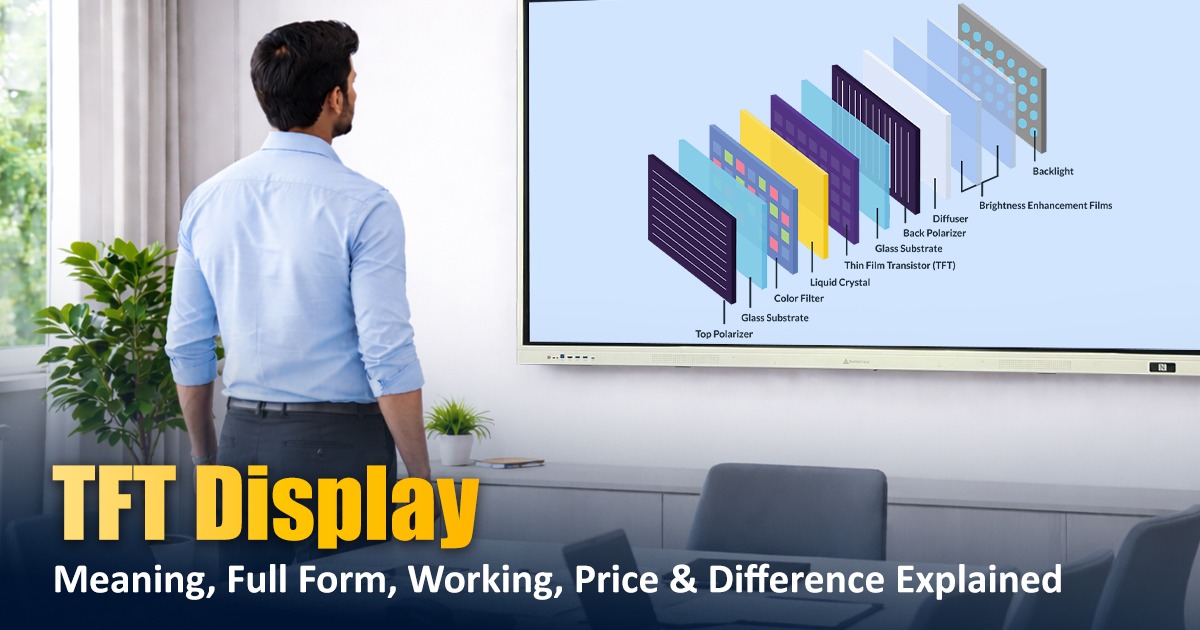
When you walk into any smart classroom, board room, hospital lab, or even a retail store, you’ll see one thing very common and this is a digital screen. In most cases, that screen is powered by a TFT display. Now this term “what is TFT display?” may sound technical for you at first glance. But once you read this article, you’ll will be able to know What TFT display is and how it works. You may surprise, you interact with TFT Display screens almost every single day, on laptops, monitors, smart boards, and even ATMs.
- What is TFT Display?
- TFT Display Full Form
- TFT Display Mean in Easy Words
- How Does a TFT Display Screen Actually Work?
- TFT Display LCD – Is It Different from LCD?
- TFT Display Monitor – Where Is It Commonly Used?
- TFT Display vs IPS – What’s the Difference?
- Advantages of TFT Display
- Are There Any Disadvantages?
- TFT Display Price – What Determines It?
- Why TFT Display Technology Is Still Relevant
- Conclusion
Let’s understand everything about TFT in simple language, without making it feel like a science lecture.
What is TFT Display?
If someone asks you, What is TFT Display? here’s the easiest way to explain this: A TFT Display is a type of LCD screen that uses tiny transistors to control each pixel individually. Because every pixel has own control switch, the image looks clearer, sharper, and more stable. That’s the reason text appears clean, crisp and videos look so smooth.
TFT Display Full Form
You must be wondering about what is full form of a TFT Display? here is answer, The TFT Display full form is Thin Film Transistor Display. This name sounds technical, but it simply talks about thin layer of transistors built into the screen that manage how images should look.
TFT Display Mean in Easy Words
If we put it in everyday language, TFT Display means an improved LCD screen that helps to give a better picture quality by managing each tiny dots. Imagine trying to control 1 million light bulbs at once versus controlling each one individually. Which one gives better results?
How Does a TFT Display Screen Actually Work?
A TFT Display screen works using liquid crystals and light.
Inside the display, there is:
- A layer of liquid crystals
- Two thin glass panels
- A backlight (usually LED)
- And a thin-film transistor for every pixel
The liquid crystals don’t produce light on their own. They act like tiny shutters. When electricity passes through the transistor, the liquid crystals adjust and control how much light passes through. Millions of these adjustments happen instantly, forming images, videos, and text. You don’t see the process. You only see the result — a clear display.
TFT Display LCD – Is It Different from LCD?
This is where confusion usually starts. People often search for “TFT LCD” thinking they are two separate technologies. Here’s the truth: TFT is a type of LCD.
Traditional LCDs used older technology called passive matrix, which was slower and less precise. TFT introduced active matrix technology, meaning every pixel has its own transistor. So when comparing TFT Display vs LCD, the difference lies in performance.
Basic LCD:
- Slower refresh
- Lower clarity
- Less sharp visuals
TFT Display LCD:
- Faster response
- Better brightness
- Sharper text and images
That’s why almost all modern LCD monitors today use TFT technology.
TFT Display Monitor – Where Is It Commonly Used?
A TFT display monitor is used almost everywhere. In education, interactive flat panels rely on TFT Display screens for clear visuals in classrooms. Teachers need sharp content visibility, especially in larger rooms. In corporate settings, TFT monitors are used in meeting rooms for presentations and video conferencing. In healthcare, medical devices use TFT screens for accurate image display.
Industrial systems, control rooms, retail digital boards — all depend heavily on TFT technology. It’s not flashy technology. It’s reliable technology. And that matters more.
TFT Display vs IPS – What’s the Difference?
Now let’s talk about something people often compare: TFT Display vs IPS.
Here’s something many don’t realize — IPS is actually a type of TFT panel.
Standard TFT panels (usually TN type):
- More affordable
- Faster response time
- Slightly limited viewing angles
IPS panels:
- Better color accuracy
- Wider viewing angles
- More consistent display from sides
- Slightly higher price
If you’re installing a large interactive display where students sit at different angles, IPS might be better. But if budget matters and the display is directly in front of the viewer, standard TFT works perfectly well.
Advantages of TFT Display
Why is TFT still so popular even after decades? Because it offers balance.
Some real advantages include:
- Clear and stable image quality
- Slim and lightweight design
- Energy efficiency
- Affordable manufacturing cost
- Fast response time
For smart boards and enterprise displays, this balance makes TFT Display technology highly practical.
Are There Any Disadvantages?
Let’s be honest — no technology is perfect.
TFT displays can have:
- Limited viewing angles (in non-IPS panels)
- Slightly weaker color depth compared to premium technologies
- Less deep blacks compared to OLED
But here’s the key thing — for education and business applications, these limitations rarely affect performance in a noticeable way.
TFT Display Price – What Determines It?
When people search for TFT Display price, they expect a fixed number. But pricing depends on several factors. Screen size plays a major role. A 21-inch monitor will cost far less than a 75-inch interactive panel. Resolution also affects cost. Higher resolution means more pixels and higher pricing. Panel type matters too. IPS panels cost more than standard TFT TN panels.
Other factors include:
- Touch functionality
- Built-in software
- Connectivity options
- Brand reputation
- Warranty
So instead of asking, “What is the price?”, it’s smarter to ask, “What features do I actually need?”
Why TFT Display Technology Is Still Relevant
With OLED and other premium display technologies entering the market, some people think TFT is outdated. That’s not true. TFT Display LCD technology continues to evolve. Manufacturers improve brightness, enhance durability, and reduce power consumption. For large-format displays like interactive flat panels, TFT remains cost-effective and scalable. And in sectors like education — where durability and clarity matter more than cinematic color depth — TFT remains a dependable choice.
It may not be the newest buzzword technology. But it is proven, stable, and practical. Sometimes reliability wins over hype.
Conclusion
So, what is TFT Display?
It is a Thin Film Transistor Display — an advanced LCD technology that delivers better clarity, faster response time, and improved brightness by controlling each pixel individually. Whether you compare TFT Display vs LCD or TFT Display vs IPS, the right choice depends on your usage, environment, and budget. For smart classrooms, enterprise meeting rooms, and professional digital display systems, TFT Display screens continue to offer the right combination of performance and affordability.
In simple words, TFT is the quiet backbone behind most modern screens you see today. And chances are, you’re reading this article on one.