What Is Simulated Teaching? Benefits, Process & Real-World Applications
September 12, 2025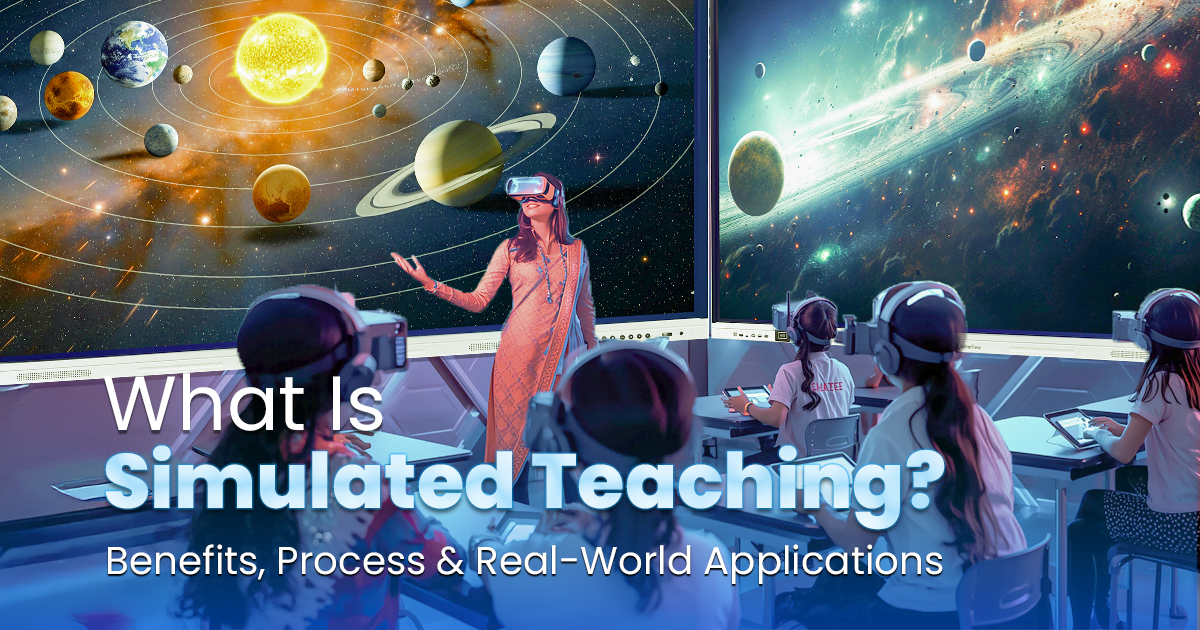
Teaching is one of the noblest profession, but also the most challenging one. For new teachers, the first few days inside a real classroom can feel overwhelming. This is where simulated teaching comes in as a powerful method of training. Instead of putting unprepared teachers directly infront of students, the simulated method of teaching gives them a safe, controlled environment to practice.
- What Is Simulated Teaching?
- Why Simulated Teaching Matters Today
- Benefits of Simulated Teaching
- Process of Simulated Teaching
- Simulated Teaching vs. Micro Teaching
- Real-World Applications of Simulated Method of Teaching
- Role of Technology in Simulated Teaching
- Challenges of Simulated Teaching
- Future of Simulated Teaching
- Conclusion
In this article, we’ll dive deep into what is simulated teaching, explore its benefits, step-by-step process, and how it applies in today’s real-world classrooms with the help of modern tools like smart boards and digital technologies.
What Is Simulated Teaching?
So, what is simulated teaching exactly?
Simulated teaching is a technique used in teacher education where trainees practice teaching in an artificial classroom environment. Instead of a full class of students, they usually teach a small group of peers, supervisors, or evaluators who play the role of students. The purpose is to give teachers-in-training a chance to rehearse lesson delivery, improve communication, and gain confidence before facing actual classrooms.
The simulated method of teaching is very similar to role-play. One person acts as a teacher, others act like students, and after the session, feedback is provided. This way, the trainee can polish skills like questioning techniques, explaining concepts, classroom management, and use of teaching aids.
Why Simulated Teaching Matters Today
In today’s education system, theory is not enough. Teachers also need practical exposure. Here’s why simulated method of teaching is becoming popular:
-
Bridges the gap between theory and practice – helps future teachers apply what they studied in real situations.
-
Safe learning space – mistakes are not costly because no actual students are harmed.
-
Builds confidence – trainees feel more prepared for real classes.
-
Skill-based training – specific teaching skills can be focused on and mastered.
For teacher training colleges, schools, and edtech companies, simulated teaching has become a standard component of professional development.
Benefits of Simulated Teaching
The benefits of simulated method of teaching go far beyond just practice. Let’s look into the main advantages:
-
Practical Experience Without Pressure
New teachers can experiment with different teaching styles without the fear of real classroom failure. -
Immediate Feedback
Supervisors and peers give suggestions instantly, so the teacher knows what went well and what needs improvement. -
Focus on Specific Skills
Skills like questioning, using visual aids, giving assignments, or handling disruptions can be practiced one by one. -
Increases Teacher Confidence
Practicing in a mock environment makes a teacher more confident when facing actual students. -
Encourages Creativity
Since the environment is flexible, teachers can try innovative methods like storytelling, interactive games, or technology integration. -
Supports Modern Education Technology
Using digital boards and smart boards in simulated sessions allows teachers to adapt to the same tools they’ll use later in classrooms.
Process of Simulated Teaching
The process of simulated teaching follows a structured pattern. Here’s the step-by-step approach:
-
Planning
The trainee selects a topic, prepares lesson plan, and identifies the skills to practice (for example: asking probing questions). -
Role Assignment
Peers or evaluators act as students, sometimes even pretending to be mischievous to make it realistic. -
Teaching Session
The trainee delivers the lesson, using chalkboard, smart board, or digital tools. -
Observation & Feedback
Observers take notes on teaching style, body language, clarity, and engagement. -
Reflection & Improvement
The trainee reflects on feedback and modifies lesson for future practice.
This cycle can be repeated until the trainee improves significantly.
Simulated Teaching vs. Micro Teaching
Often people confuse simulated teaching with micro-teaching. While both are used in teacher training, they are slightly different.
-
Micro-teaching focuses on teaching a very small unit of a subject in short time (5–10 minutes) to practice one skill.
-
Simulated teaching focuses on imitating a real classroom, with role-play and multiple skills practiced together.
In simple words: micro is like practicing a single shot, while simulated teaching is like rehearsing the entire scene.
Real-World Applications of Simulated Method of Teaching
Simulated teaching is not just theory. It is already being applied widely in different areas:
-
Teacher Education Institutes
B.Ed and M.Ed programs use simulated teaching as part of their training curriculum. -
Professional Development
Schools organize workshops where teachers role-play classroom situations to upgrade their skills. -
EdTech Platforms
Digital platforms now provide virtual classroom simulations for teacher training. -
Corporate Training
Even outside education, simulated teaching methods are used to train employees in soft skills and presentations. -
Technology-Enhanced Learning
Smart boards, projectors, and virtual reality tools are being integrated to make simulations more realistic and engaging.
Role of Technology in Simulated Teaching
Modern classrooms are no longer limited to blackboard and chalk. With the arrival of smart boards and interactive digital boards, simulated teaching has become more effective.
For example:
-
A teacher trainee can prepare slides on a smart board and deliver the lesson to peers.
-
Sessions can be recorded for later analysis.
-
Interactive tools (annotations, polls, quizzes) can be used to make the simulation engaging.
For companies like DeltaView, which provide interactive flat panels, this creates a strong link: simulated teaching becomes not only a training practice but also a demonstration of how digital boards support teaching skills.
Challenges of Simulated Teaching
Like any method, simulated teaching also has some limitations:
-
Sometimes, the artificial environment does not capture real classroom dynamics.
-
It requires time and resources for organizing role-play sessions.
-
Some trainees may not take the simulation seriously.
But with proper guidance, realistic role-play, and integration of digital boards, most of these challenges can be minimized.
Future of Simulated Teaching
The future of simulated method of teaching looks promising. As education technology continues to grow, simulations will get more advanced. Virtual classrooms, AI-based student avatars, and interactive boards will make teacher training highly immersive.
Imagine a teacher practicing infront of a digital screen where AI-generated students ask real-time questions. This is no longer far away.
Conclusion
So, what is simulated teaching? In simple words, it’s a training method where teachers practice in a safe, controlled environment before facing real students. The simulated method of teaching builds confidence, provides feedback, and develops essential teaching skills.
With the addition of smart boards and digital technologies, simulated teaching is becoming more powerful, more realistic, and more impactful. For any teacher training program or institution, adopting simulated teaching is not just an option anymore – it is a necessity.
FAQs
Simulated teaching is a training method where teacher trainees practice in a mock classroom environment with peers or evaluators acting as students.
Micro teaching focuses on one skill in a short lesson, while simulated teaching recreates a full classroom experience with multiple skills practiced together.
It builds confidence, provides immediate feedback, improves teaching skills, and allows safe practice without risking real classroom outcomes.
Smart boards, interactive flat panels, and virtual classroom tools make simulations more realistic and prepare teachers for modern classrooms.
It is widely used in teacher training institutes, professional development workshops, edtech platforms, and even corporate training programs.