What is NEP 2020? How Smart Boards are Powering Classrooms
May 31, 2025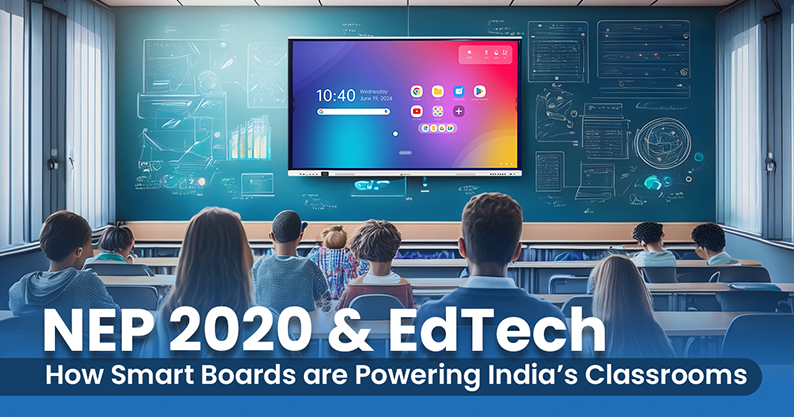
National Education Policy 2020 (NEP 2020) that seeks to revolutionize education in India. EdTech – Educational technology plays a vital role in achieving the goal and objectives of NEP 2020. Know What is NEP 2020? Being a reputed smart board provider for education, DeltaView is working towards to bridge the gap between policy vision and modern classroom.
What is NEP 2020?
If you don’t know about NEP 2020 you must be wondering what is NEP 2020?, Let us tell you that NEP 2020 is India’s first education policy of 21st century. This is replacing previous policy that was formulated in the 1986. It has aim to focus on flexible, holistic, and multidisciplinary education. It’s suited to the needs of 21st century and aims to bring out the unique capabilities of each student.
Key highlights of NEP 2020:
-
Early Childhood Care & Education (ECCE) – Strong foundation for children aged 3-8 years.
-
New School Structure (5+3+3+4) – Replaces the old 10+2 system to better suit child development stages.
-
Focus on Foundational Literacy and Numeracy – Ensuring every child achieves basic reading and math skills by Grade 3.
-
Vocational Education – Introduction of skill-based training from Grade 6 onwards.
-
Multilingualism – Promoting the use of local languages as the medium of instruction.
-
Technology Integration – Encouraging use of digital tools and smart classrooms.
How Smart Boards Are Powering Modern Classrooms
Smart boards, also known as interactive flat panels or digital whiteboards, are touchscreen boards that connect to computers and the internet. They are replacing traditional blackboards in many schools and colleges.
Benefits of Smart Boards in Education:
1. Interactive Learning
-
Teachers can show videos, animations, and real-time examples.
-
Students can touch and interact with the screen.
-
Makes difficult concepts easier to understand.
2. Multimedia Support
-
Combine audio, video, images, and text for better engagement.
-
Use of educational apps, presentations, and simulations.
-
Encourages visual learning and audio-visual teaching methods.
3. Digital Content Access
-
Teachers can access online teaching material instantly.
-
Enables the use of NCERT digital books, question banks, and worksheets.
-
Saves time and enhances lesson delivery.
4. Improved Student Participation
-
Students are more motivated to take part in smart board lessons.
-
Group activities and quizzes become more fun and competitive.
-
Encourages collaborative learning.
5. Real-Time Assessment
-
Teachers can conduct polls, quizzes, and assessments on the spot.
-
Immediate feedback helps students learn faster.
-
Tracks student progress efficiently.
6. Support for Blended Learning
-
Ideal for both online and offline classrooms.
-
Smart boards can be used for virtual classes via platforms like Zoom, Google Meet, and Microsoft Teams.
NEP 2020 + Smart Boards = Future-Ready Classrooms
NEP 2020 emphasizes the use of digital tools for inclusive and equitable education. Smart boards are perfectly aligned with this vision. Here’s how:
1. Promotes Experiential Learning
-
NEP 2020 promotes learning through experience.
-
Smart boards allow interactive experiments, case studies, and simulations.
2. Bridges Urban-Rural Gap
-
Smart boards help provide quality education in rural schools.
-
Digital content can be accessed even in remote areas using pre-loaded content or offline apps.
3. Supports Multilingual Teaching
-
Smart boards can display content in multiple languages.
-
Helps in delivering lessons in mother tongue/local language, as suggested by NEP.
4. Teacher Empowerment
-
NEP 2020 stresses on teacher training.
-
Smart boards make it easier for teachers to create and deliver digital content confidently.
5. Inclusive Education
-
Supports students with disabilities through features like:
-
Text-to-speech
-
Magnifiers
-
Video explanations
-
Sign language videos
-
Smart Boards: A Step Towards Digital India
The vision of a Digital India is to make technology accessible in every corner of the country. Smart boards are helping in:
-
Building 21st-century skills like critical thinking, creativity, and digital literacy.
-
Reducing dropouts by making learning enjoyable.
-
Connecting schools to the National Digital Education Architecture (NDEAR).
Best Use Cases of Smart Boards in Indian Classrooms
-
Science Labs: Virtual experiments, 3D models, and live demonstrations.
-
Math Classes: Real-time solving of problems and interactive quizzes.
-
Language Learning: Grammar games, pronunciation videos, and story animations.
-
Social Studies: Interactive maps, timelines, and historical videos.
-
Primary Education: Fun animations, rhymes, and visual storytelling.
Top Features to Look for in a Smart Board for School
When choosing a smart board, look for:
-
4K UHD display quality
-
Multi-touch support (at least 20 points)
-
Built-in Android and Windows compatibility
-
Screen recording and whiteboard apps
-
Wi-Fi, USB, and HDMI ports
-
Wireless screen sharing
-
Durability and warranty support
Final Thoughts
NEP 2020 is not just a policy — it’s a vision for transforming India’s education system. The integration of smart boards in classrooms is a powerful step toward realizing this vision. With interactive technology, digital boards, and student-centered learning, smart boards are not just upgrading classrooms — they are shaping the future of education in India.
Digital classrooms + Smart Boards + NEP 2020 = Smarter India
FAQs
NEP 2020 is India’s first education policy of 21st century.
Yes, they help make teaching more engaging, effective, and aligned with digital education trends encouraged by NEP 2020.
Yes, many smart boards come with built-in content and can work offline with USB drives or pre-loaded apps.
Smart boards are touchscreen, don't need a separate projector, and offer better clarity, interactivity, and durability.
They save time, improve lesson delivery, help track student performance, and make teaching more fun and efficient.
They enable digital learning, multilingual content, interactive teaching, and skill-based education — all goals of NEP 2020.