How DeltaView Smart Boards Improve Students Engagement
December 31, 2025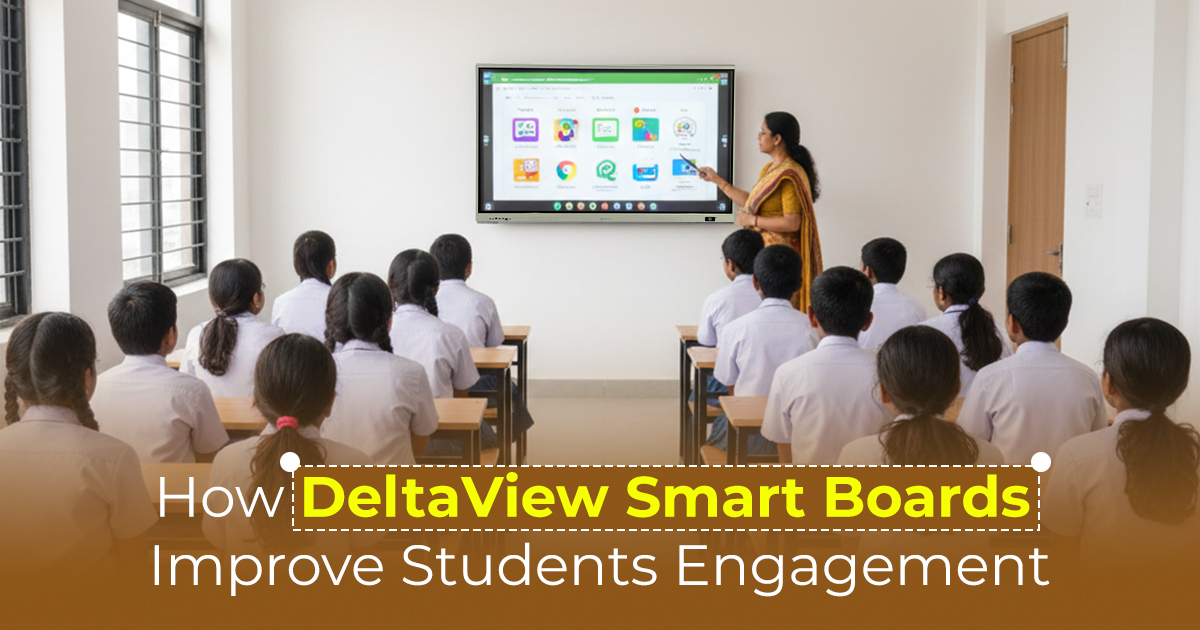
Walk into a classroom today and you’ll notice something has changed. Students don’t want to just sit, listen, and copy notes anymore. They want to see, touch, respond, and participate. Attention spans are shorter, curiosity is higher, and learning expectations have evolved. This is exactly where smart boards are making a real difference.
- Why Student Engagement Is a Real Challenge Today
- What Makes a Smart Board Different from a Normal Board
- From Passive Learning to Active Participation
- Visual Learning Makes Concepts Stick
- Smart Board for Classroom: Making Learning Feel Real
- How Smart Boards Support Smart Class Culture
- Smart Board for Teachers: Teaching Becomes Easier
- Better Use of Teaching Learning Materials (TLM)
- Alignment with NEP2020 Goals
- EdTech Integration Enhances Engagement
- Smart Board Price: Value Beyond Cost
- Encouraging Every Student to Participate
- Challenges and Practical Solutions
- The Future of Classrooms Is Interactive
- Conclusion
A smart board for teaching use is not just a digital upgrade—it’s a shift in how students experience learning. When used correctly, it turns lessons into conversations, concepts into visuals, and classrooms into active learning spaces.
Let’s explore how smart boards genuinely improve student engagement, not in theory, but in everyday classroom reality.
Why Student Engagement Is a Real Challenge Today
Traditional teaching methods worked well in the past because distractions were limited. Today’s students grow up surrounded by screens, visuals, and instant information. Expecting them to stay engaged with only textbooks and verbal explanations is unrealistic.
In many classrooms:
- Students lose focus quickly
- Only a few participate actively
- Learning feels repetitive
- Concepts remain abstract
This doesn’t mean teachers aren’t trying. It means the tools need to match the learners. That’s where smart classroom technology steps in.
What Makes a Smart Board Different from a Normal Board
A smart board is an interactive display that allows teachers and students to:
- Write using fingers or pens
- Show videos, animations, and diagrams
- Open digital textbooks and TLM
- Conduct quizzes and activities instantly
Unlike a blackboard or whiteboard, a smart board reacts to touch. It responds. It invites interaction. And that simple change has a powerful impact on how students engage.
From Passive Learning to Active Participation
In a traditional class, learning is mostly one-way. The teacher explains, students listen. With a smart board for classroom, learning becomes two-way.
- Students come to the board.
- They solve problems.
- They move objects.
- They answer questions.
- They explain ideas.
The moment students participate physically, their attention increases naturally. Engagement stops being forced—it becomes automatic.
Visual Learning Makes Concepts Stick
Not every student learns the same way. Some understand better by reading, some by listening, and many by seeing.
Smart boards support visual learning beautifully:
- Animated science experiments
- Geography maps that zoom and move
- Maths problems explained step-by-step
- Historical events shown through visuals
When students can see what’s being explained, concepts stop feeling confusing. Understanding improves, and so does confidence.
Smart Board for Classroom: Making Learning Feel Real
A smart board for classroom use helps connect lessons to real life. Instead of imagining a process, students watch it unfold on screen.
For example:
- A biology lesson becomes a live animation
- A physics concept turns into a simulation
- A language class includes audio and visuals
This realism keeps students interested because learning no longer feels distant or abstract.
How Smart Boards Support Smart Class Culture
A smart class is not about technology alone. It’s about interaction, collaboration, and curiosity.
Smart boards encourage:
- Group discussions
- Peer learning
- Classroom debates
- Student presentations
When students work together on the board, learning becomes social. They learn not only from teachers, but also from each other.
Smart Board for Teachers: Teaching Becomes Easier
Smart boards don’t replace teachers—they support them.
For teachers, smart boards help by:
- Reducing repetitive writing
- Organizing lessons better
- Saving time during explanations
- Managing class attention effectively
Instead of spending energy on writing and erasing, teachers focus on explaining, guiding, and engaging students.
Better Use of Teaching Learning Materials (TLM)
TLM plays a crucial role in learning outcomes. Traditional TLM like charts and printed worksheets have limitations.
With smart boards:
- Digital TLM is reusable
- Content can be updated easily
- Lessons stay aligned with curriculum
- Engagement remains high
Interactive TLM helps students remember concepts longer because learning involves action, not just observation.
Alignment with NEP2020 Goals
NEP2020 emphasizes:
- Experiential learning
- Conceptual understanding
- Digital literacy
- Student-centric education
Smart boards directly support these goals. They encourage exploration instead of memorization. Students learn by doing, questioning, and interacting—exactly what NEP2020 promotes.
EdTech Integration Enhances Engagement
Smart boards work smoothly with edtech platforms and digital tools. Teachers can:
- Access online content
- Use educational apps
- Conduct instant assessments
- Track student understanding
This integration makes classrooms future-ready and keeps students interested in how they learn.
Smart Board Price: Value Beyond Cost
Many schools worry about smart board price, but the focus should be on value, not just cost.
Smart boards offer:
- Long-term use
- Reduced printing expenses
- Reusable digital content
- Improved learning outcomes
When engagement improves, results improve. And that makes the investment worthwhile.
Encouraging Every Student to Participate
In a smart classroom, engagement is not limited to confident students. Even quieter students feel comfortable participating through:
- On-screen quizzes
- Visual answers
- Group activities
Smart boards create a safe space where students can engage without fear of being wrong.
Challenges and Practical Solutions
Like any technology, smart boards need:
- Basic teacher training
- Reliable power and internet
- Gradual adoption
Once these are in place, the transition becomes smooth. Most teachers adapt quickly when they see how much easier teaching becomes.
The Future of Classrooms Is Interactive
Education is moving forward, and classrooms must evolve with it. Smart boards are no longer optional tools—they are becoming essential for meaningful engagement.
As smart classroom adoption grows across India, especially with NEP2020 and edtech expansion, student engagement will continue to improve.
Conclusion
Smart boards don’t magically make students smarter—but they make learning more engaging, interactive, and effective. By transforming lessons into experiences, smart boards help students stay curious, involved, and confident.
A smart board for teaching is not about technology. It’s about connection—between students, teachers, and knowledge. And that connection is what truly drives engagement.
FAQs
Yes. Interactive visuals and activities naturally hold student interest better than traditional methods.
Absolutely. They are effective across maths, science, languages, and humanities.
No. With minimal training, teachers adapt quickly and often prefer smart boards.
They encourage experiential learning, digital skills, and concept-based education.
Considering long-term benefits and improved engagement, smart boards offer strong value.