How DeltaView AI Smart Boards Are Redefining Smart Classrooms
March 20, 2026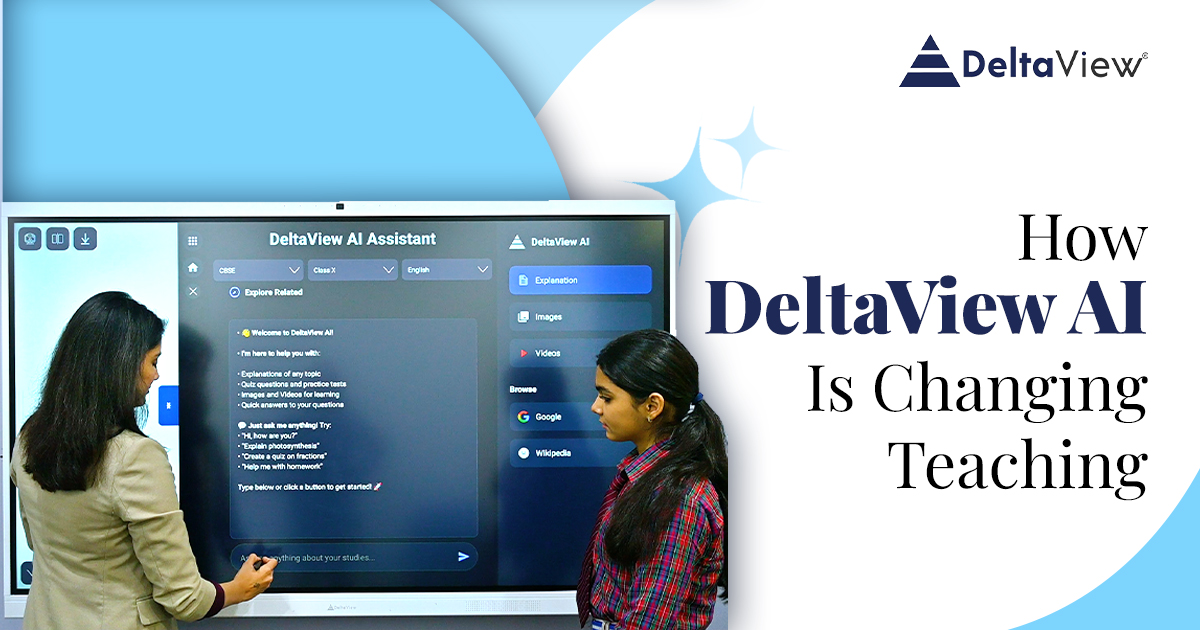
If you walk into a classroom today, you’ll probably notice a shift right away. The blackboard is no longer the center of attention. In many places, it has been replaced by a smart board for teaching, and honestly, that change has been coming for a while.
- Smart Board for Teaching and the Reality Inside Classrooms
- Smart Board for Teaching Meets AI: Why We Built DeltaView AI
- Smart Board for Teaching with Real-Time AI Support
- Smart Board for Teaching That Adapts to the Teacher
- What We’ve Noticed After Bringing AI into Classrooms
- Smart Board for Teaching and the Future of Smart Classrooms
- Final Thought
But from our experience at DeltaView, simply installing a smart board doesn’t automatically improve teaching. It definitely helps—no doubt about that—but the real difference comes from how it’s used during a live class. Because teaching is not static.
A teacher might walk in with a plan, but within minutes, things can change. A student asks something unexpected. A concept needs a different explanation. A diagram suddenly becomes necessary. These small moments shape the entire learning experience. That’s exactly where we felt something was missing.
Smart Board for Teaching and the Reality Inside Classrooms
We’ve spent a lot of time observing real classrooms—not just the ideal ones, but the everyday ones. And one thing stood out. Most teachers are not struggling because they lack knowledge. They struggle because they have to manage everything at once. Explaining, writing, answering, adjusting—all in real time.
A smart board for teaching already makes things easier by bringing content, visuals, and writing into one place. Teachers can open presentations, play videos, or write directly on the screen without switching devices. That alone improves the flow of teaching.
But even with all of that, there are still moments where teachers need something more immediate—something that helps right then and there. That’s the gap we focused on.
Smart Board for Teaching Meets AI: Why We Built DeltaView AI
At DeltaView, we asked ourselves a very simple question: What if a smart board for teaching could actually support the teacher in the moment, not just display content? That question led to DeltaView AI.
We didn’t want to create something complex or overwhelming. We wanted something that feels natural to use—something that quietly helps without getting in the way. So instead of adding layers of complicated features, we focused on real classroom needs.
Smart Board for Teaching with Real-Time AI Support
When you combine a smart board for teaching with AI, the experience changes in subtle but important ways.
Let’s say you’re in the middle of a lesson, and a student asks something slightly off-topic but still relevant. Normally, you might pause, think, or try to simplify the answer quickly.
With DeltaView AI, you can get a clear explanation almost instantly. Not something overly detailed—just something structured enough to explain confidently and move forward.
Then there are situations where words are not enough.
Some topics just need a visual. Instead of drawing it manually or searching for it, you can generate a clean diagram within seconds. It saves time, and more importantly, it helps students understand faster.
There are also moments when a short visual explanation works better than anything else. That’s where quick video generation comes in. It’s not about replacing teaching, but supporting it with an extra layer of clarity.
And then there’s the most common challenge—finding information without breaking the flow.
With integrated access, teachers don’t need to switch devices or pause the class. Everything stays in one place, and the teaching continues naturally.
Smart Board for Teaching That Adapts to the Teacher
One thing we’ve always believed is that every teacher has their own way of teaching. Some rely more on explanation. Some prefer visuals. Some like interaction. A smart board for teaching should adapt to the teacher—not the other way around.
That’s why DeltaView Smart Boards are designed to feel familiar. Teachers can write naturally, move between content easily, and use tools without needing extra effort. The addition of AI doesn’t change that—it just enhances it. It adds support where needed, without forcing a new way of teaching.
What We’ve Noticed After Bringing AI into Classrooms
We’re careful about making big claims, but there are a few patterns we’ve consistently seen.
Teachers seem more relaxed during the class. Not because their job has become easier, but because they don’t feel stuck in unexpected moments.
Lessons feel more flexible. They don’t have to follow a strict structure anymore.
Students, on the other hand, stay engaged a bit longer—especially when concepts are supported by visuals or quick explanations.
And interestingly, classrooms feel more interactive without forcing interaction.
Smart Board for Teaching and the Future of Smart Classrooms
The idea of a smart classroom is evolving. It’s no longer just about having digital screens or modern infrastructure. It’s about creating an environment where teaching flows naturally and learning becomes easier.
From our perspective, a smart board for teaching is the foundation. But AI is what makes it more responsive, more adaptive, and more useful in real situations.
We don’t see AI replacing teachers. That’s not the goal. We see it as something that reduces pressure, saves time, and helps teachers focus on what actually matters—students.
Final Thought
At DeltaView, we didn’t set out to build just another smart board. We wanted to improve what happens during a real class. Because that’s where the real impact is.
A smart board for teaching already brings structure and flexibility into the classroom. With DeltaView AI, it also brings support—right at the moment it’s needed. And sometimes, that small difference is what makes a class truly effective.
FAQs
A smart board for teaching is an interactive digital screen that allows teachers to write, show videos, display images, and access online content—all in one place. Unlike a traditional blackboard, it makes lessons more visual and interactive, which helps students understand concepts more easily.
DeltaView AI adds an extra layer of support to the smart board. It helps teachers with instant explanations, quick visuals, and real-time content generation. Instead of spending time searching or preparing everything in advance, teachers can handle things during the class itself.
No, it is designed to be simple and practical. Teachers can use it without needing technical expertise. The idea is to support their existing teaching style, not force them to learn something completely new.